
From Chaos to Clarity: How Tab Management Became the Secret Weapon of Top Performers
The highest performers you know probably have the same internet you do. They use the same tools. They open tabs, browse research, click around, and fall into rabbit holes just like everyone else.
So why do they seem to move faster, get more done, and always be two steps ahead?
It’s not a secret mindset. It’s not some hidden software.
It’s how they manage attention – specifically, how they manage tabs.
Because in today’s work world, the way you handle your browser tabs is the way you handle your brain.
Why Tab Management Matters More Than You Think
Your browser is where everything starts. Research. Strategy. Invoicing. Brainstorms. Calendar planning. Competitive analysis. Hiring. Design. Development. Sales decks. Content writing.
The tabs you open are the seeds of every project, every decision, every insight.
But most people treat tabs like throwaway scratch paper – open one, scan, move on. If it feels important, they might leave it open “for later.” Problem is, later never comes. Or it comes too late, buried behind 40 others. So they reopen it. Or search again. Or give up.
Multiply this behavior by 100 times a week, and you start to understand why so many smart people stay stuck in digital chaos.
Top performers? They don’t live that way.
They don’t waste time wondering where something is.
They don’t rely on memory to track the flow of their thinking.
They don’t let their browser control their attention.
They control it.
What Chaos Looks Like
Let’s be honest. We’ve all been there.
– 25 tabs open.
– 6 of them playing audio.
– 3 of them duplicates.
– Half of them titled “Home” or “Pricing” or “Blog” with no clue what they’re about.
– You’re toggling between them, trying to remember which one had the quote you liked or the feature list you needed.
You tell yourself it’s part of the process. That creative minds are messy. That tabs are free, so why not?
But deep down, you know the truth: every open tab is a broken thought. A task unfinished. A project suspended in a kind of digital limbo. And the longer it stays there, the harder it is to act.
This is the chaos that kills progress.
What Clarity Looks Like
Now picture this instead:
– You have 3–5 tabs open. Each one matters.
– You saved 12 more, but they’re organized into a labeled box you can return to.
– You know exactly what each saved link is about, because you named it when you saved it.
– When you’re working on something, all the pieces you need are grouped, easy to find, and already waiting for you.
This is what top performers do differently. They don’t just close tabs.
They contain them.
They don’t just save links.
They label them.
They don’t just work in the browser.
They build systems inside it.
How Tab Management Becomes a Competitive Advantage
When you manage your tabs intentionally, a few things happen – fast:
-
You stop repeating yourself. No more re-Googling, re-reading, or trying to “find that one article again.”
-
You gain mental space. Open loops get closed. You’re not juggling 19 half-done thoughts while trying to do deep work.
-
You improve recall. Saving a link and naming it reinforces memory. You’ll find you need to search less – because you remember more.
-
You get faster. Research becomes faster. Project switching becomes faster. Delegation becomes faster – because everything is findable.
-
You feel in control. And that’s the real payoff. Not more work, but more control over your own workflow.
High performers don’t have more time. They just lose less of it.
Why Webloggle Fits the Flow
Most tab managers are either too complicated or too limited. Some want you to build entire workflows. Others just suspend tabs to save memory. But neither of those solves the real problem: how do I quickly save a link, name it, and return to it later – without changing how I work?
That’s exactly what Webloggle does.
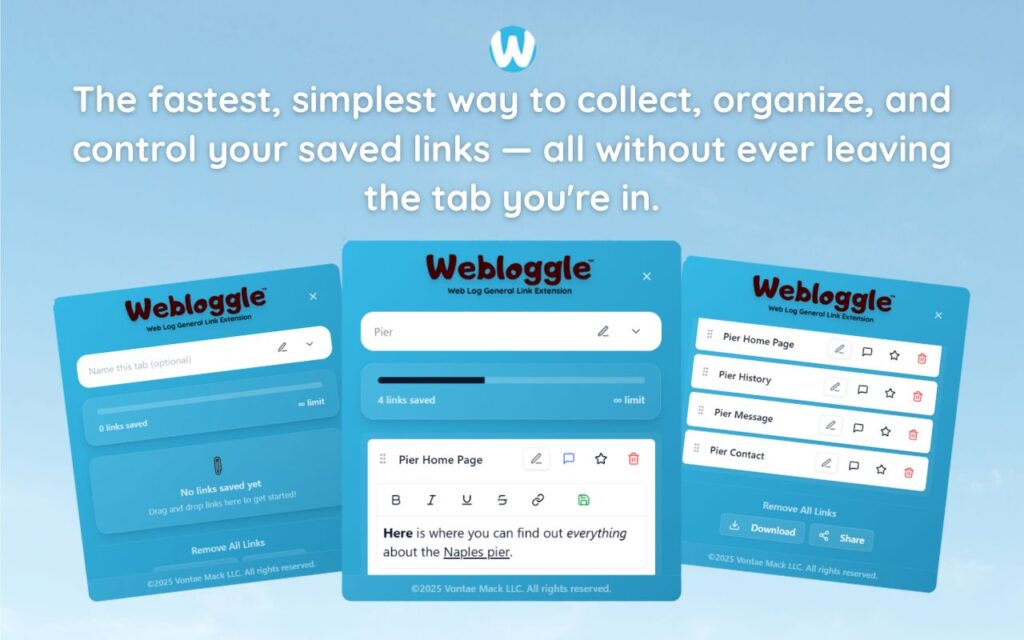
You drag a link to the icon. You name the box. You move on.
It doesn’t interrupt your flow – it preserves it.
It doesn’t ask you to become someone else – it works with the habits you already have.
It’s a simple, quiet tool that turns your browser into a personal assistant. One that doesn’t forget, doesn’t lose things, and doesn’t clutter your head.
The Naming Trick That Changes Everything
When you start naming the things you save, a strange thing happens: you start thinking more clearly.
Why?
Because giving something a name forces your brain to assign meaning. It makes you stop and ask: “Why does this matter? What does this connect to? What is this for?”
That one-second pause creates a mental link. And suddenly, your saved tab isn’t just a vague promise for later—it’s a labeled piece of your larger thought process. One you can pick back up instantly.
Top performers do this naturally. They write notes. They title documents. They save screenshots into named folders.
Webloggle brings that same clarity to your browsing habits.
From Fragmented to Fluid
Without tab management, your browser becomes a pile of fragments:
-
Half-baked ideas
-
Incomplete research
-
Open-ended projects
-
Missed references
With a tool like Webloggle, you start to turn those fragments into frameworks.
You save things in context. You build boxes of knowledge. You reduce friction between thought and action.
And over time, you become someone whose browser reflects a mind in motion, not a mind stuck in overload.
How to Start
You don’t need a productivity makeover. You don’t need to change everything.
You just need to start saving links on purpose.
Here’s a system you can try today:
-
Pick one project. Something you’re actively working on.
-
Create a box in Webloggle. Name it exactly what the project is – “Client Redesign,” “Job Search,” “UX Inspiration,” whatever.
-
Drag related links into it. Each time you come across something relevant, save it. Rename the link to something meaningful if you want.
-
Return to that box later. Pick up where you left off. Add, delete, export. It’s all in one place.
Do this consistently, and your tabs stop being distractions – and start becoming assets.
Final Word
The way you manage your tabs might seem like a small thing.
But in a world where every idea, every task, every decision, and every opportunity starts in your browser, it’s not.
It’s the difference between working hard and working smart.
It’s the difference between always being busy – and finally feeling clear.
From chaos to clarity. That’s the shift.
Webloggle just makes it effortless.
Free Version
Try Webloggle Free
-
Collect In-tab Links
Drag and drop links into icon or box, right click to save.
-
Edit Link Titles
Name your links whatever you'd like.
-
Create Webloggle Bookmarks Folder
Click the star to create bookmarks of saved links.
-
Limited To The Main Tab Only
Upgrade to Webloggle Pro to use unlimited Tabs.
MOST POPULAR
Webloggle Pro offers you complete control over your tabs.
-
Collect In-tab Links
Drag and drop links into the icon, box, right click to save.
-
Edit Link Titles
Pro offers more robust link naming.
-
Create Webloggle Bookmarks Folder
Click the star to create bookmarks of saved links.
-
Add unlimited notes via WYSIWYG editor.
Bold, Underline, Italics, More Links? Webloggle Pro has you covered!
-
Name each tab individually
Name tab boxes anything you'd like.
-
Choose Tabs by Dropdown
Need to save a link in a different named Tab? With Webloggle Pro you can!
-
Download Your Saved Tabs To Your Computer - Links, Notes, Everything
Webloggle Pro sets your mind at ease with the ability to save all your necessary links, notes, etc to your own computer.
-
Share With Anyone!
Use the Share button in Webloggle Pro to embed your tab information practically anywhere!
Monthly Plan
Webloggle's Monthly Plan offers you complete control over your tabs.
-
Everything in the Yearly Plan is included.
This monthly plan offers everything available in the yearly plan.
