
What 10,000 Open Tabs Say About You — and Why You Should Care
If your browser has become a graveyard of good intentions, you’re not alone.
Maybe it starts with research for work. Then a couple of tabs for personal projects. Then something someone shared on social. Then something you found in a newsletter. Then a product comparison you didn’t finish, a YouTube video you plan to watch later, and an article you want to read when you “have more time.”
Fast forward a week – or a month – and you’re staring at rows of tiny tab icons, dozens of them, maybe hundreds. In some cases, thousands. You don’t want to close them. You don’t want to lose them. So you keep them open.
You tell yourself it’s fine. But your brain knows better.
Because those 10,000 open tabs? They’re not just clutter. They’re a message.
Here’s what they’re trying to tell you.
You’re Curious – But You’re Drowning
A massive pile of tabs isn’t a sign of laziness. It’s a sign of curiosity. You’re interested in a lot of things. You explore. You investigate. You want to learn, plan, and understand. That’s not a problem. That’s a strength.
But curiosity without structure creates mental drag. You can’t pursue everything at once. And trying to hold it all in one giant line of open tabs is like trying to write a book by taping sticky notes to your ceiling. It’s ambitious – but it’s not sustainable.
You’re not failing because you’re curious. You’re stuck because there’s no container for that curiosity. So it leaks out everywhere.
You’re Holding on to Things You Might Need—But Can’t Actually Use
Most tabs stay open because you think, “I might need this later.” That’s totally rational. The problem is you can’t find it later.
A title like “Home” or “Pricing | MyApp” or “10 Tips for Better…” isn’t searchable in your mind. Even if you could remember why you saved it, you’d need to skim through a wall of similar tabs to figure out which one mattered. It’s like trying to remember which sticky note had the important phone number – but there are 200 of them, and none are labeled.
Leaving tabs open doesn’t actually help you remember. It helps you avoid the decision of what to do with it.
You don’t want to lose it, so you leave it there.
But guess what? It’s lost anyway.
You’re Thinking in Fragments—Not Systems
Ten thousand tabs say you’re working in bursts.
A tab for this idea. A tab for that one. A tab for research, another for execution. A tab for distraction when you’re tired. A tab for later when you’re motivated.
But what you don’t have is a system to turn those fragments into something cohesive.
Most people don’t need fewer ideas. They need a better way to organize them. Without that, the ideas get buried under their own weight. It’s not lack of creativity – it’s lack of containment.
If you don’t name and group what matters, you’re not building a body of knowledge. You’re just tossing pages into the wind and hoping they come back when you need them.
You’re Letting the Browser Lead – Instead of You
Your browser should be your assistant, not your boss.
When you open a tab, it should be on your terms: this is useful, I know why, I know where I’ll find it later. When you let tabs pile up without intention, you’re not making decisions – you’re avoiding them. And the longer the list grows, the more passive your work becomes.
You start reacting to the tab in front of you, instead of working from what actually matters.
That’s how you lose hours – chasing links, re-reading things you already found, and drifting between scattered half-thoughts with no real endpoint.
You’re Not Lazy. You’re Under-Tooled.
If your tabs are chaos, it’s not because you lack discipline.
It’s because your tools don’t support the way you actually think.
Browsers were built to help you visit pages, not return to them in a meaningful way. Bookmarks are clunky and hidden. History is overwhelming. Tab groups collapse into another layer of forgetfulness. And dedicated “read later” apps often become digital junk drawers you never revisit.
What you need isn’t a new productivity system. You need a browser experience that works with your brain – not against it.
Here’s What to Do Instead
Step one: Stop trying to hold everything in your browser tabs.
Step two: Start saving links intentionally.
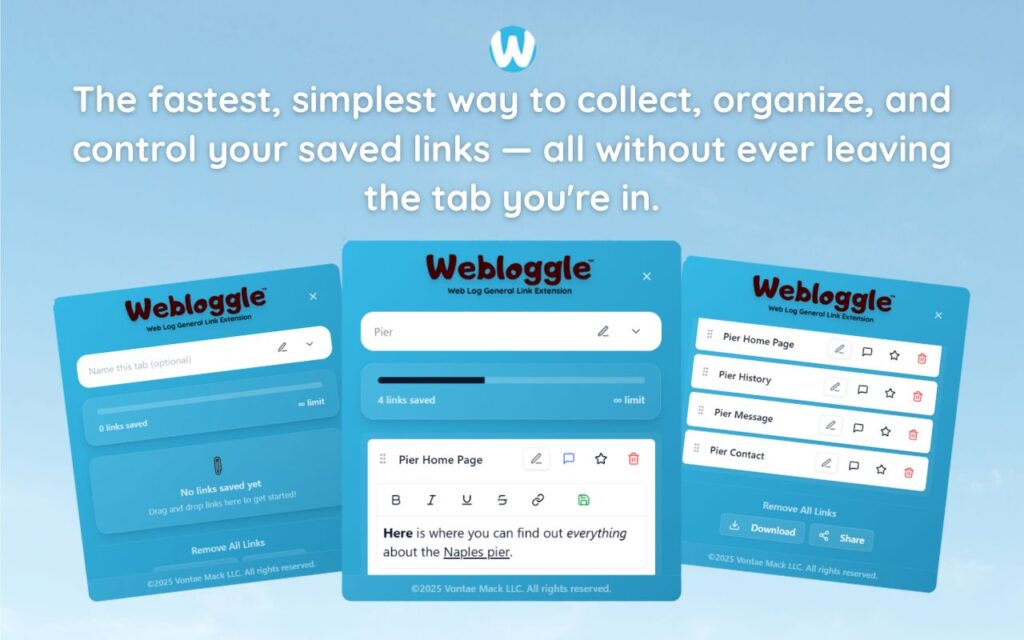
That’s where a tool like Webloggle comes in. It’s not a folder system. It’s not a traditional bookmark manager. It’s not another app to log into or learn.
It’s a dead-simple way to name what matters.
-
Drag a tab to the Webloggle icon.
-
Assign it to a box – like “Client Research,” “Writing Ideas,” or “Must Read.”
-
Give it a name you’ll recognize.
-
That’s it.
Now instead of holding 500 tabs open, you have everything stored where it belongs. You can close tabs without fear. You can find what you need when you need it. You can move between projects without breaking focus.
And best of all – you get your browser (and your brain) back.
What Top Performers Do Differently
High-functioning teams and individuals don’t waste time clicking through endless tabs.
They label their digital work.
They build systems that turn curiosity into knowledge, and knowledge into action.
They don’t rely on memory. They rely on retrieval.
Every useful page they come across is stored on purpose, with context, and a plan for return.
This doesn’t just improve productivity. It improves clarity. Momentum. Confidence.
Because when you know where everything is, you stop worrying about what you’ve forgotten.
From Overload to Ownership
10,000 tabs means you care.
It means you’re exploring. Trying. Building something.
But it also means you’re at risk of losing the very ideas you’re trying to preserve.
The answer isn’t fewer ideas – it’s better architecture.
It’s not discipline. It’s design.
And once you shift from chaotic tabs to organized thought, the entire way you work changes.
You go from someone who’s constantly “catching up” to someone who’s always prepared.
From someone who keeps saying “I know I saw that somewhere…” to someone who clicks once – and it’s there.
The Bottom Line
Your tabs say a lot about you.
They say you’re thinking big.
They say you’re juggling a lot.
They say you want to remember what matters.
What they don’t say – what they can’t say – is where to find it all again.
That’s where you take back control.
Close the tabs.
Save the links.
Name what matters.
Webloggle is how you go from scattered to sharp.
And once you start working that way, you’ll never go back.
Free Version
Try Webloggle Free
-
Collect In-tab Links
Drag and drop links into icon or box, right click to save.
-
Edit Link Titles
Name your links whatever you'd like.
-
Create Webloggle Bookmarks Folder
Click the star to create bookmarks of saved links.
-
Limited To The Main Tab Only
Upgrade to Webloggle Pro to use unlimited Tabs.
MOST POPULAR
Webloggle Pro offers you complete control over your tabs.
-
Collect In-tab Links
Drag and drop links into the icon, box, right click to save.
-
Edit Link Titles
Pro offers more robust link naming.
-
Create Webloggle Bookmarks Folder
Click the star to create bookmarks of saved links.
-
Add unlimited notes via WYSIWYG editor.
Bold, Underline, Italics, More Links? Webloggle Pro has you covered!
-
Name each tab individually
Name tab boxes anything you'd like.
-
Choose Tabs by Dropdown
Need to save a link in a different named Tab? With Webloggle Pro you can!
-
Download Your Saved Tabs To Your Computer - Links, Notes, Everything
Webloggle Pro sets your mind at ease with the ability to save all your necessary links, notes, etc to your own computer.
-
Share With Anyone!
Use the Share button in Webloggle Pro to embed your tab information practically anywhere!
Monthly Plan
Webloggle's Monthly Plan offers you complete control over your tabs.
-
Everything in the Yearly Plan is included.
This monthly plan offers everything available in the yearly plan.
