Why You Always Lose Important Links (And What To Do About It)
You don’t lose links because you’re lazy, forgetful, or disorganized. You lose them because the modern browser was never built to handle the way your brain actually works.
Let’s start with what really happens. You’re working on something – maybe researching a new software tool, reading up on a competitor, pulling up resources for a pitch deck, or diving into an article that sparked a big idea. You don’t finish. You’re interrupted. Or you tell yourself, “I’ll get back to this later.” You open a new tab. Then another. Then ten more. Maybe you keep the original one open. Maybe you don’t. Either way, the moment you move on, that valuable link begins its slow march toward oblivion.
The Tab Trap
Tabs feel temporary. They’re supposed to. That’s what makes them so addictive. Open, scan, decide later. But what happens is a kind of digital purgatory – half-read articles, semi-formed thoughts, barely-started projects, all floating in suspended animation.
You think you’ll remember what’s in each tab. You won’t. You think it’ll be easy to go back later. It won’t. That tab you left open from Tuesday? By Friday, it’s joined 40 others. It’s just another rectangle with a logo and three cut-off words. And if you did close it, you told yourself it wasn’t important. Until a week later, when you find yourself trying to Google it again. The phrase escapes you. The exact source is buried under similar results. You can’t find it. It’s gone.
Bookmarks Don’t Help Either
The problem with bookmarks isn’t that they don’t work – it’s that they work like file cabinets in a world moving at the speed of TikTok. You create a folder, name it something generic like “Resources” or “Read Later,” and dump links in like junk mail. Six months go by. You never open the folder again.
That’s because bookmarks aren’t dynamic. They’re not fluid. They’re not how you think. They’re rigid, fixed, and designed like the internet was still 90% static pages and forums. They don’t keep pace with the way you collect, revisit, and build on information now.
The Real Cost
Lost links aren’t just lost pages. They’re lost time. Lost ideas. Lost momentum. That one article you wanted to reference in a client pitch? Gone. That niche tool that could’ve saved your team hours? Forgot the name. That killer insight you read at 11pm last Tuesday night? All you remember is that it had something to do with “context switching” and maybe the site had a blue header?
Every time you lose a link, you lose the potential thread it could have unraveled. The connection it might have sparked. The task it could have finished. The rabbit hole it might have rightly taken you down. And if you’re someone whose work depends on research, insight, and synthesis – this loss compounds fast.
Why You Keep Doing It Anyway
This isn’t a personal failing. It’s a systems problem.
You lose important links because browsers were made for browsing – not for remembering. Not for organizing. Not for turning fragments into frameworks. The tools you were given (tabs, bookmarks, history) were never designed to be cognitive partners. They’re utilities. You’re forcing them to act like an external brain, and they weren’t built for that.
Even extensions that try to help tend to overcomplicate things. Some want you to sign up for an account, create folders inside folders, tag everything with keywords, or assign priority scores. It becomes its own project. You don’t need more friction. You need flow.
What You Actually Need
You need a simple, frictionless system that lets you save links the moment they matter—and retrieve them the moment they matter again. No guesswork. No digging. No wondering what a tab titled “The” was supposed to mean.
You need something that lives inside your browser, not outside of it. Something fast. Something light. Something that doesn’t ask you to change how you think – but adapts to how you already work.
You don’t need AI. You don’t need a second monitor. You don’t need another app open just to track what you’re already doing online.
You need a way to name what’s in front of you. To sort as you go. To stack meaning on top of your daily digital habits – without slowing down.
Enter Webloggle
Webloggle isn’t a to-do list. It’s not a project manager. It’s not a bookmarking service pretending to be social media.
It’s a simple tab companion that lets you save links with purpose.
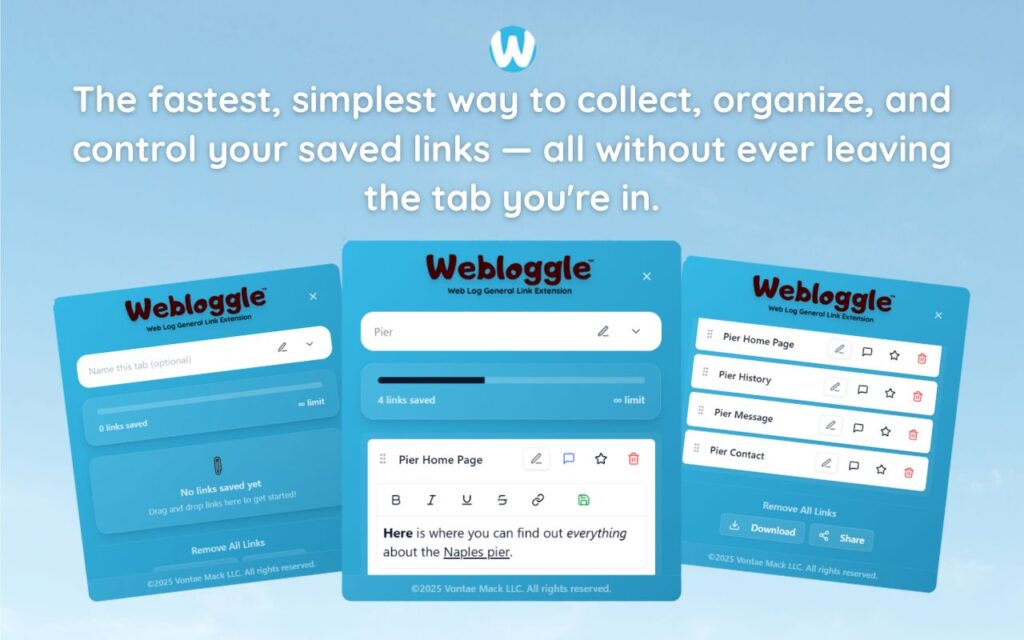
You drag a link to the icon. Done.
You name the box where it lives. Done.
You re-open it later and know exactly why it’s there.
You can rename saved links. Delete what’s no longer relevant. Export what matters to a CSV if you want to archive it somewhere else.
But most of all – you see it. It’s not hidden. It’s not buried under 80 other tabs. It’s labeled, grouped, ready to go. The same way your mind was when you decided to keep it in the first place.
Why This Works
We think in context. Not in file paths. Not in keywords. Not in URLs.
That article about dopamine loops? Maybe it’s part of your research for a talk you’re giving. That landing page with a slick layout? Maybe it’s inspiration for a redesign next quarter. That pricing strategy blog? You’re planning a pitch for a new client.
Saving links without labeling them is like jotting down thoughts in a notebook with no page numbers. It feels productive in the moment. But good luck finding anything when it counts.
Webloggle lets you name the moment. It’s the browser version of writing a title on a folder, instead of stuffing it into a drawer.
Stop Losing Momentum
The next time you go to close a tab and think, “I might want this later,” ask yourself: do you trust yourself to remember why? Or when? Or what for?
And if the answer is no, stop relying on memory.
Start relying on method.
Save the link. Name it. Get back to it when it matters.
That’s not just smarter browsing – it’s future-proof thinking.
Conclusion
You lose important links not because you don’t care, but because your tools never respected the importance of what you were doing. Until now.
Webloggle doesn’t promise to change how you think.
It helps you hold onto what you already thought – before it disappears into the noise.
You’ve lost your last great link.
Now you can keep the next one.
Free Version
Try Webloggle Free
-
Collect In-tab Links
Drag and drop links into icon or box, right click to save.
-
Edit Link Titles
Name your links whatever you'd like.
-
Create Webloggle Bookmarks Folder
Click the star to create bookmarks of saved links.
-
Limited To The Main Tab Only
Upgrade to Webloggle Pro to use unlimited Tabs.
MOST POPULAR
Webloggle Pro offers you complete control over your tabs.
-
Collect In-tab Links
Drag and drop links into the icon, box, right click to save.
-
Edit Link Titles
Pro offers more robust link naming.
-
Create Webloggle Bookmarks Folder
Click the star to create bookmarks of saved links.
-
Add unlimited notes via WYSIWYG editor.
Bold, Underline, Italics, More Links? Webloggle Pro has you covered!
-
Name each tab individually
Name tab boxes anything you'd like.
-
Choose Tabs by Dropdown
Need to save a link in a different named Tab? With Webloggle Pro you can!
-
Download Your Saved Tabs To Your Computer - Links, Notes, Everything
Webloggle Pro sets your mind at ease with the ability to save all your necessary links, notes, etc to your own computer.
-
Share With Anyone!
Use the Share button in Webloggle Pro to embed your tab information practically anywhere!
Monthly Plan
Webloggle's Monthly Plan offers you complete control over your tabs.
-
Everything in the Yearly Plan is included.
This monthly plan offers everything available in the yearly plan.
